

Deep Groove Ball Bearing
What Is Deep Groove Ball Bearing
Deep groove ball bearings are the most widely used bearing type and are particularly versatile. They have low friction and are optimized for low noise and low vibration which enables high rotational speeds.
Benefits of Deep Groove Ball Bearing
Versatility
Unlike most types of ball bearings, deep groove bearings are able to handle both radial and axial loads. This is notable, because it opens the number of applications for the bearing up, making it a good option for a number of industries. With a wider range of applications, deep groove ball bearings are relied upon to handle a number of jobs that would otherwise require a combination of different types of bearing. Adaptability is key in many areas, making the versatility of deep groove ball bearings a quality choice for many different uses.
Cost savings
A deep groove ball bearing creates less friction torque than other types of bearings. This results in a lower operating temperature, extending the lifespan of the ball bearing. With an extended lifespan, that means fewer equipment failures or need for replacement. In addition, the reduced friction torque lowers the energy required to run equipment like compressors and fans, lowering energy bills as well.
Reduced upkeep
With a simplified design, low friction torque, and low operating temperature, a deep groove ball bearing has a much longer expected lifespan than other types of bearing. They also don’t require any additional lubrication after they are installed, which means fewer work stoppages for maintenance. No matter where they are being used, their reliability and near self-sufficiency make deep groove ball bearings a good choice for a number of uses.
-
![6310 Deep Groove Ball Bearing]() 6310 Deep Groove Ball BearingSXA 60 Series Deep Groove Ball Bearings | High-Speed Low-Noise | ISO9001 & EU REACH/RoHS Certified | Models 6300-6310read more
6310 Deep Groove Ball BearingSXA 60 Series Deep Groove Ball Bearings | High-Speed Low-Noise | ISO9001 & EU REACH/RoHS Certified | Models 6300-6310read more -
![6309 Deep Groove Ball Bearing]() 6309 Deep Groove Ball BearingSXA 60 Series Deep Groove Ball Bearings | High-Speed Low-Noise | ISO9001 & EU REACH/RoHS Certified | Models 6300-6310read more
6309 Deep Groove Ball BearingSXA 60 Series Deep Groove Ball Bearings | High-Speed Low-Noise | ISO9001 & EU REACH/RoHS Certified | Models 6300-6310read more -
![6308 Deep Groove Ball Bearing]() 6308 Deep Groove Ball BearingSXA 60 Series Deep Groove Ball Bearings | High-Speed Low-Noise | ISO9001 & EU REACH/RoHS Certified | Models 6300-6310read more
6308 Deep Groove Ball BearingSXA 60 Series Deep Groove Ball Bearings | High-Speed Low-Noise | ISO9001 & EU REACH/RoHS Certified | Models 6300-6310read more -
![6307 Deep Groove Ball Bearing]() 6307 Deep Groove Ball BearingSXA 60 Series Deep Groove Ball Bearings | High-Speed Low-Noise | ISO9001 & EU REACH/RoHS Certified | Models 6300-6310read more
6307 Deep Groove Ball BearingSXA 60 Series Deep Groove Ball Bearings | High-Speed Low-Noise | ISO9001 & EU REACH/RoHS Certified | Models 6300-6310read more -
![6306 Deep Groove Ball Bearing]() 6306 Deep Groove Ball BearingSXA 60 Series Deep Groove Ball Bearings | High-Speed Low-Noise | ISO9001 & EU REACH/RoHS Certified | Models 6300-6310read more
6306 Deep Groove Ball BearingSXA 60 Series Deep Groove Ball Bearings | High-Speed Low-Noise | ISO9001 & EU REACH/RoHS Certified | Models 6300-6310read more -
![6305 Deep Groove Ball Bearing]() 6305 Deep Groove Ball BearingSXA 60 Series Deep Groove Ball Bearings | High-Speed Low-Noise | ISO9001 & EU REACH/RoHS Certified | Models 6300-6310read more
6305 Deep Groove Ball BearingSXA 60 Series Deep Groove Ball Bearings | High-Speed Low-Noise | ISO9001 & EU REACH/RoHS Certified | Models 6300-6310read more -
![6304 Deep Groove Ball Bearing]() 6304 Deep Groove Ball BearingSXA 60 Series Deep Groove Ball Bearings | High-Speed Low-Noise | ISO9001 & EU REACH/RoHS Certified | Models 6300-6310read more
6304 Deep Groove Ball BearingSXA 60 Series Deep Groove Ball Bearings | High-Speed Low-Noise | ISO9001 & EU REACH/RoHS Certified | Models 6300-6310read more -
![6303 Deep Groove Ball Bearing]() 6303 Deep Groove Ball BearingSXA 60 Series Deep Groove Ball Bearings | High-Speed Low-Noise | ISO9001 & EU REACH/RoHS Certified | Models 6300-6310read more
6303 Deep Groove Ball BearingSXA 60 Series Deep Groove Ball Bearings | High-Speed Low-Noise | ISO9001 & EU REACH/RoHS Certified | Models 6300-6310read more -
![6302 Deep Groove Ball Bearing]() 6302 Deep Groove Ball BearingSXA 60 Series Deep Groove Ball Bearings | High-Speed Low-Noise | ISO9001 & EU REACH/RoHS Certified | Models 6300-6310read more
6302 Deep Groove Ball BearingSXA 60 Series Deep Groove Ball Bearings | High-Speed Low-Noise | ISO9001 & EU REACH/RoHS Certified | Models 6300-6310read more -
![6301 Deep Groove Ball Bearing]() 6301 Deep Groove Ball BearingSXA 60 Series Deep Groove Ball Bearings | High-Speed Low-Noise | ISO9001 & EU REACH/RoHS Certified | Models 6300-6310read more
6301 Deep Groove Ball BearingSXA 60 Series Deep Groove Ball Bearings | High-Speed Low-Noise | ISO9001 & EU REACH/RoHS Certified | Models 6300-6310read more -
![6300 Deep Groove Ball Bearing]() 6300 Deep Groove Ball BearingSXA 60 Series Deep Groove Ball Bearings | High-Speed Low-Noise | ISO9001 & EU REACH/RoHS Certified | Models 6300-6310read more
6300 Deep Groove Ball BearingSXA 60 Series Deep Groove Ball Bearings | High-Speed Low-Noise | ISO9001 & EU REACH/RoHS Certified | Models 6300-6310read more -
![639 Deep Groove Ball Bearing]() 639 Deep Groove Ball BearingSXA 60 Series Deep Groove Ball Bearings | High-Speed Low-Noise | ISO9001 & EU REACH/RoHS Certified | Models 633-639read more
639 Deep Groove Ball BearingSXA 60 Series Deep Groove Ball Bearings | High-Speed Low-Noise | ISO9001 & EU REACH/RoHS Certified | Models 633-639read more


Quality Assurance: ISO9001, IS014001, ISO45001, IATF16949, high-tech enterprise, specialized new enterprise.
Cutting-edge technology: The company has its own bearing parts factory, which produces rings, cages, shield and seals, which can deal with flexible and diverse Market demand.
Quality Services: We have a professional R&D and design team that designs and develops according to customer requirements and usage conditions.Professional guidance on the use and installation of bearings, making every effort to ensure bearing quality, and fully cooperating with after-sales service.
Deep groove ball bearing are made up of four main components: Two rings (or races), the balls (which are the rolling elements), and the retainer (which separates the balls). Deep groove ball bearing and radial ball bearings feature an inner and outer ring. These bearings are designed to support radial loads, which are forces applied perpendicular to the axis of rotation.
The outer race remains stationary and is mounted in the housing. It helps transfer the radial load from the bearing to the housing. The inner race, mounted on the rotating shaft, supports and guides the shaft during rotation. The rolling elements are responsible for carrying and distributing the load across the raceways.
The rolling elements rotate at a different speed from the speed of the inner race, but they rotate around the inner race. The separator functions as a barrier that prevents the balls from bumping into each other. The separator is situated between the balls. Thrust bearings support loads that are parallel to the axis of rotation, which are referred to as axial loads. Thrust ball bearings consist of two rings of equal size.

What Is The Application Of Deep Groove Ball Bearing?
General machinery and electric motors
One of the most common applications for deep groove ball bearings is in electric motors and general machinery. Their ability to handle moderate speeds and provide quiet and efficient operation makes them ideal for these applications. They are often found in household appliances, power tools, fans, and other small to medium-sized electric motors.
Automotive industry
In the automotive sector, deep groove ball bearings are used in various components such as alternators, starters, clutches, and transmissions. Their robustness and reliability under varying operational conditions make them suitable for automotive applications.
Industrial gearboxes
Gearboxes, which require precise and efficient rotation, often employ deep groove ball bearings. Their ability to handle both radial and axial loads efficiently while maintaining low friction is advantageous in these applications.
Pumps and compressors
Pumps and compressors, which are essential components in many industrial processes, also utilize these bearings. They are chosen for their capacity to operate reliably under high radial loads and at varying speed conditions.
Agricultural machinery
In the agricultural sector, equipment like tractors, combines, and other machinery often incorporate deep groove ball bearings due to their durability and ability to operate effectively in environments with dust and moisture.
Material handling systems
Conveyor systems and other material handling equipment rely on these bearings for smooth operation. Their ability to support radial loads and handle moderate axial loads is essential in the smooth and efficient movement of materials.
Precision instruments
In precision applications, such as in medical equipment or high-speed machinery, deep groove ball bearings are valued for their running accuracy and low noise levels.
Recreational applications
They are also used in recreational applications like skateboards, inline skates, and bicycles, where their compactness and efficiency in handling both radial and axial loads are crucial.
Types of Deep Groove Ball Bearing
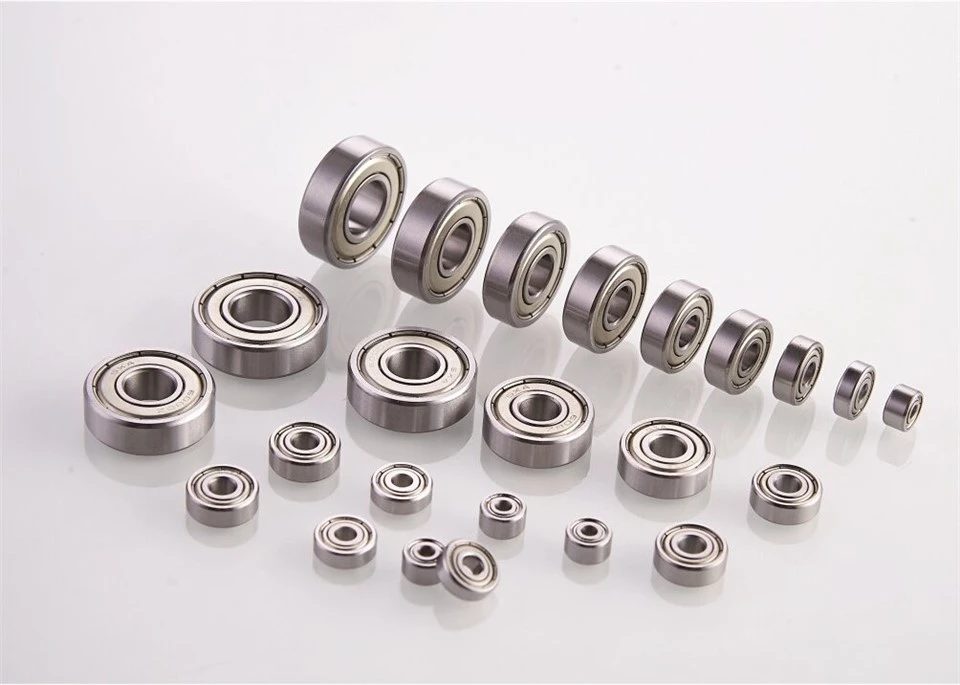
Single-Row Deep Groove Ball Bearings
This is the typical deep groove ball bearing that has a single raceway. These are usually robust and made from durable materials, ensuring that these bearings have an extended service life.
Single-row deep groove ball bearings are also subdivided into other types, ranging from 3 mm to 400 mm bore sizes, suitable for almost any application. Some manufacturers will also offer thin, narrow, wide, or miniature bearings depending on clients' needs.
Since deep groove ball bearings need to withstand extreme conditions, manufacturers also offer ceramic-coated bearings to handle electric pitting and high-temperature units that can withstand up to 660 degrees F.
One of the latest developments in single-row deep groove ball bearings is the sensor-bearing unit, which can measure the status of the ball bearing components. These units are simple and easy to use and can help with speed sensing, angular position measuring, and steering, making them useful in electric motors, tractors, conveyors, and road rollers.
Sealed Deep Groove Ball Bearings
Sealed deep groove ball bearings are similar to single-row bearings, except that they have steel or rubber shields installed on one or both sides of the bearing. These seals are pre-lubricated with grease to extend the lifespan of the bearing.
Many manufacturers used sealed ball bearings in contaminated environments that may otherwise influence the performance of the bearing. The shields help the bearing retain grease while also preventing any contaminants from entering the bearing itself.
Larger deep groove ball bearings may even use machined brass cages for high-speed applications, where the cage prevents unwanted wear and tear.
Flanged Deep Groove Ball Bearings
Some deep groove ball bearings come with a flanged outer ring, which works similarly to a snap ring on standard ball bearings. The flange improves the bearing's running efficiency and is also easier to machine due to the simplicity of the housing bore.
Flanged deep groove ball bearings are excellent for bearing axial loads, such as in tube ends or on belt guide rollers. Some variants even have swivel housing to allow for slight misalignments and better axial loads.
Double-Row Deep Groove Ball Bearings
The double-row design allows for a significantly higher load carrying capacity while still retaining the bearing's low friction characteristics. Double-row bearings are usually just slightly wider than their single-row counterparts, making them almost as versatile and practical.
The main drawback of double-row deep groove ball bearings is that they do not come with seals or shields, though some may be fitted with cages. These cages assist with installation and assembly but are susceptible to mechanical stresses during operation. It's vital to choose the right type of cage for the specific application, especially as some cage materials are sensitive to specific lubricants.
Maximum Type Ball Bearings
These ball bearings have many more rolling elements than their single and double-row counterparts. These additional balls allow for higher performance and higher precision without sacrificing efficiency or longevity. Like single-row deep groove ball bearings, they can be either open or shielded, depending on the application and requirements.
Factors Influencing Quality of Deep Groove Ball Bearings
Steel grade
The durability and life of the bearings relies on the composition of the steel utilized.
Heat treatments
This process is essential to harden bearings, making them sturdier and long-lasting.
Grinding
The grinding cycle ensures the smoothness of the bearing's inner and outer ring which is why it needs to be ground over many cycles.
Design conformity
A bearing can perform better if its dimensional accuracy is closer to the design standards.
Why Deep Groove Ball Bearings Are Better Than Conventional Bearings
Support bi-directional forces: The straightforward construction of deep groove ball bearings contributes to their ability to handle axial and radial loads in both directions.
High speeds: Deep groove ball bearings have a higher speed as compared to roller bearings because of the reduced contact between the rolling elements and the presence of raceways.
Improve load capacity: Because of the bearings' designs, less stress is imposed due to the equal transfer of the weight between races. This makes it suitable for heavy machinery equipment.
Versatile: Aside from heavy machinery, the deep groove can also be found in domestic applications such as refrigerators, motors, fans and pumps as it can reduce friction with minimal noise.
Enhanced and better radial load capacity: Conventional bearings do not have the heightened radial support that deep groove ball bearings do. Boasting superior radial-load carrying capabilities makes them a better choice.
Easy maintenance: Several design characteristics make their maintenance relatively easy such as shields and sealed which protects them against contamination. It is also built with multiple lubrication options which requires very minimal maintenance over time.
Our Factory
Ningbo New Century Bearing Co., Ltd. was established in October 1987. It is a manufacturer specializing in the production of precision miniature bearings. The registered trademarks are "SX" and "SXA". The company covers an area of 52,000 square meters and a workshop area of 43,000 square meters. The R&D team composed of professional engineers has more than 350 skilled workers, with an annual output of 90 million sets.
The company has its own bearing parts factory, which produces rings, cages, shield and seals, which can deal with flexible and diverse Market demand. The product types mainly include deep groove ball bearings, flange bearings, stainless steel bearings. Bearing precision can reach P5 level (ABEC-5), and the noise can reach Z4V4. Ultra-thin-wall miniature bearings are the company's specialty products.

Asked Questions
We're professional deep groove ball bearing manufacturers and suppliers in China. If you're going to wholesale deep groove ball bearing made in China, welcome to get quotation from our factory. Also, customized service is available.